> For the complete documentation index, see [llms.txt](https://docs.probly.com/llms.txt). Markdown versions of documentation pages are available by appending `.md` to page URLs; this page is available as [Markdown](https://docs.probly.com/get-started/readme.md).
# What is Probly?
Before it happens. — An overview of Probly and how prediction markets work.
## Overview
**Probly — before it happens.** Trade real-world outcomes by buying **YES** or **NO** shares on a question. Prices reflect the market's view of how likely each side is to win.
> Buy **YES** at **15¢** on *"Will BTC reach $100k this week?"* The price implies a **15% chance**. If it happens, each share redeems for **$1.00** — turning **$0.15** into **$1.00** (**$0.85 profit** per share). If not, the shares settle at **$0**.
## How a Share Works
Every market asks a yes/no question. You can buy two things:
* A **YES share** — worth **$1.00** if the event happens, **$0** if not
* A **NO share** — worth **$1.00** if the event doesn't happen, **$0** if it does
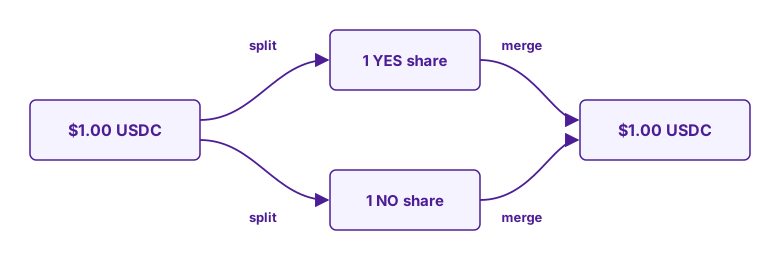
Since exactly one side will be right, **1 YES + 1 NO = $1.00** at all times.
Three rules follow from this:
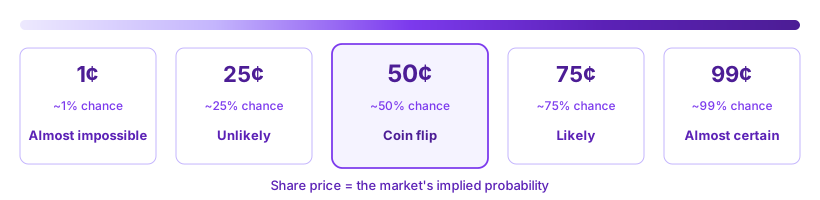
* **YES price + NO price ≈ $1.00.** YES at 60¢ ⇒ NO ≈ 40¢.
* **Price = implied probability.** YES at 60¢ ⇒ the market sees a **60% chance**.
* **Prices stay between 1¢ and 99¢** — closer to 99¢ means more likely; closer to 1¢ means less.
## How Trading Works
1. **Pick a market** — Crypto, sports, politics, and more.
2. **Buy YES or NO** at the current price.
3. **Hold or sell early** — Sell anytime before the deadline to lock in profit or cut losses.
4. **Settle automatically** — At resolution, winning shares pay **$1.00** and losing shares go to **$0**. USDC lands in your account; no claim step needed.
## At a Glance
| | |
| --------------------- | ---------------------------------------------------------------- |
| **Collateral** | USDC |
| **Share price range** | **1¢ – 99¢** ($0.01 – $0.99) |
| **Payout on win** | $1.00 per share |
| **Payout on loss** | $0 per share |
| **Market cycles** | 5-minute, 15-minute, hourly, daily, weekly, and long-form events |
## Where to Next
* [Making Your First Trade](/get-started/first-trade.md) — Get trading in minutes.
* [Trading Overview](/markets-and-trading/overview.md) — How the order book works.
## Join the Community
Chat with traders and the Probly team on [Discord](https://discord.gg/H82vHXEW) or [Twitter](https://x.com/ProblyHQ).
Need help? Use the **support** channel in the footer at [probly.com](https://probly.com), or reach out at ****.
---
# Agent Instructions
This documentation is published with GitBook. GitBook is the documentation platform designed so that both humans and AI agents can read, navigate, and reason over technical content effectively. Learn more at gitbook.com.
## Querying This Documentation
If you need additional information that is not directly available in this page, you can query the documentation dynamically by asking a question.
Perform an HTTP GET request on the current page URL with the `ask` query parameter, and the optional `goal` query parameter:
```
GET https://docs.probly.com/get-started/readme.md?ask=&goal=
```
`ask` is the immediate question: it should be specific, self-contained, and written in natural language.
`goal` is optional and describes the broader end goal you are ultimately trying to accomplish on behalf of the user. GitBook uses it to tailor the answer towards what is most useful for that goal.
The response will contain a direct answer to the question and relevant excerpts and sources from the documentation.
Use this mechanism when the answer is not explicitly present in the current page, you need clarification or additional context, or you want to retrieve related documentation sections.